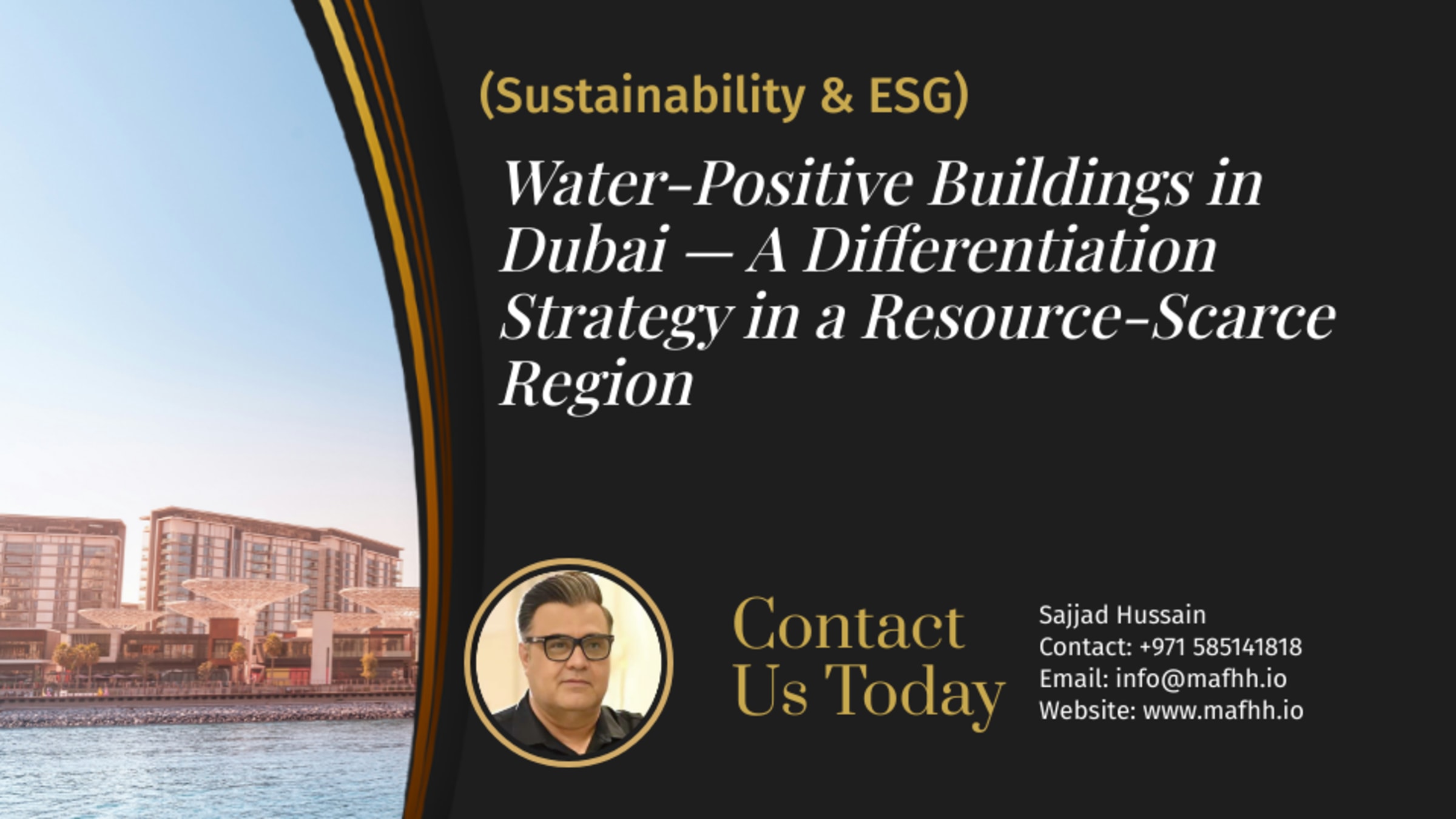
Water-Positive Buildings in Dubai — A Differentiation Strategy in a Resource-Scarce Region
Dubai receives less than 100 millimetres of rainfall annually yet consistently commands per-square-metre valuations that outpace London, Singapore, and Frankfurt — a paradox that institutional allocators are now stress-testing at the underwriting stage.
Water-positive buildings are assets engineered to produce or recycle more water than they consume, through condensate recovery systems, greywater reuse infrastructure, and atmospheric water generation. In a market where desalination supplies over 98% of potable water, this design standard is not an environmental credential — it is an operational cost advantage embedded directly in NOI.
Capital without a resource-efficiency thesis is mispriced in Dubai.
ESG mandates from European and North American LPs, Dubai Municipality's Green Building Regulations and Specifications, and the UAE Net Zero 2050 roadmap are converging into a single compliance ceiling. Conventional assets cannot clear it without material retrofit capital expenditure. Institutional allocators and sovereign funds now apply the same analytical rigour to water-efficiency metrics as they apply to cap rate, debt service coverage, and cash-on-cash return. The repricing is not approaching — it is already embedded in how sophisticated capital underwrites GCC real estate.
Why Water-Positive Design Resets the Underwriting Calculus for Dubai Real Estate
A water-positive building produces or recycles more water than it consumes — deploying condensate recovery systems, greywater reuse loops, and atmospheric water generation to eliminate net dependence on municipal supply. This is not an architectural flourish. It is a direct intervention in the NOI equation.
Dubai sources over 98% of its potable water through energy-intensive desalination. That supply chain converts into one of the highest per-unit water costs in the GCC — a recurring operational drag that compounds across every year of a hold period and compresses NOI with the consistency of a fixed liability.
Resource efficiency certifications — Estidama Pearl ratings, LEED Platinum — translate that compression into measurable reversal. Certified assets carry lower vacancy risk, higher tenant retention, and debt service coverage ratios that hold under stress scenarios where conventional buildings deteriorate.
Water costs are not a utility line item. They are an underwriting variable.
The IRR divergence between a water-positive asset and a comparable conventional building over a 10-year hold is not marginal — operational savings, valuation premiums, and reduced capital expenditure at exit create a compounding gap that resets the return profile entirely. Institutional allocators and family offices now screen for resource-efficiency metrics at the same rigour applied to cap rate and cash-on-cash return. The screening criterion has changed. The underwriting model must follow.
Water Scarcity in a Resource-Scarce Region Is Not a Future Risk — It Is a Present Pricing Variable
UAE aquifers are being drawn at 20 times their natural recharge rate. That is not a modelled projection — it is a measured depletion curve with no reversal mechanism at current consumption levels. The supply constraint is permanent.
Dubai's desalination infrastructure delivers over 98% of potable water to the emirate. That infrastructure is energy-intensive, cost-volatile, and exposed to regional supply chain disruptions that no developer controls and no underwriting assumption can absorb indefinitely.
Water scarcity is already inside the price.
Dubai Municipality's Green Building Regulations and Specifications — combined with the UAE Net Zero 2050 roadmap — establish a compliance ceiling that conventional buildings cannot reach without substantial retrofit capital expenditure. That expenditure compresses future NOI before a single tenant vacates. Owners who deferred water-efficiency investment at the design stage now carry that liability in their debt service coverage ratios.
Sovereign wealth funds and institutional allocators active in the GCC have integrated climate-adjusted water risk directly into their underwriting models. Resource-intensity metrics sit alongside cap rate and cash-on-cash return in their screening criteria — not as ESG decoration, but as fundamental risk variables.
The differentiation strategy of water-positive buildings in Dubai is a response to a structural market repricing already underway.
How Water-Positive Buildings in Dubai Attract Private Capital Through ESG-Aligned Deal Flow
European and North American institutional allocators no longer treat ESG performance as a supplementary screen — it is a hard gate. Before capital flows into GCC real estate, LPs require auditable environmental performance data: resource-intensity ratios, Scope 3 disclosure-ready metrics, and third-party certification. Conventional Dubai assets fail this screen at the first review.
Water-positive buildings clear it at the design stage.
Condensate recovery volumes, greywater reuse rates, and atmospheric water generation outputs are quantifiable, reportable, and directly mappable to the disclosure frameworks institutional allocators present to their own boards. That auditability removes friction from the capital raise process — the asset's ESG narrative is not constructed post-close; it is embedded in the underwriting package from day one.
ESG alignment is the entry condition, not the differentiator.
Mafhh Real Estate operates precisely at this intersection — connecting developers and fund managers building water-efficient assets with vetted private capital through a relationship-first network where ESG alignment is a pre-qualification criterion on both sides of every introduction. The result is a structurally compressed timeline between deal origination and LP commitment.
Developers who integrate water-positive credentials at design stage — not as a retrofit afterthought — command tighter spreads and shorter raise cycles. The capital advantage is not incidental. It is the direct output of building an asset that speaks the language institutional allocators already require.
The Asset-Level Metrics That Make Water-Positive Buildings a Durable Differentiation Strategy
Water-positive certified assets in Dubai trade at 8–15% above comparable non-certified stock on a per-square-foot basis. That premium is not driven by amenity perception — it is anchored in lower cap rate compression risk across the hold period, because the operating cost floor is structurally lower and the regulatory exposure is contained.
Tenant retention reinforces the valuation case. Occupiers carrying their own Scope 3 reporting obligations actively select assets that support compliance, and lease renewal rates in resource-efficient buildings reflect that preference directly. Vacancy risk compresses. NOI stability improves. The underwriting holds under stress scenarios where conventional assets deteriorate.
ESG credentials determine exit optionality.
Exit liquidity for a water-positive asset is categorically broader. Sovereign funds, REIT structures, and cross-border institutional buyers operating exclusion lists remove non-ESG stock from consideration before underwriting begins. A water-positive building qualifies for that entire buyer universe. A conventional building does not.
In the GCC context, reinvestment capital behaves with the same logic driving 1031 exchange decisions in the U.S. market — it flows toward assets with the lowest long-term regulatory and tax-risk profile. Water-positive credentials satisfy that criterion.
Water-positive buildings are not a niche strategy — they are the minimum viable asset for any 10-year investment horizon in Dubai.
The Repricing Is Already Happening — Position Ahead of It
Dubai's water constraint is not a future scenario to model in sensitivity analysis — it is a present cost variable already embedded in NOI, underwriting spreads, and LP qualification criteria. Buildings that resolve that constraint at the asset level do not merely perform better on paper. They attract deeper capital, hold value across cycles, and exit into a broader buyer universe than conventional stock will ever access.
Mafhh Real Estate connects developers and fund managers building water-positive assets with the vetted private capital that already prioritises resource-efficiency as a pre-qualification criterion. The introductions happen through relationships where alignment precedes the term sheet — which is precisely why they close.
Water-positive design is not a differentiator for the next market cycle.
It is the baseline for any asset built to hold, exit, or raise institutional capital in Dubai's resource-constrained environment. The developers who recognised that first are not waiting for the market to catch up.
In a scarce-resource market, the asset that solves scarcity owns the capital.